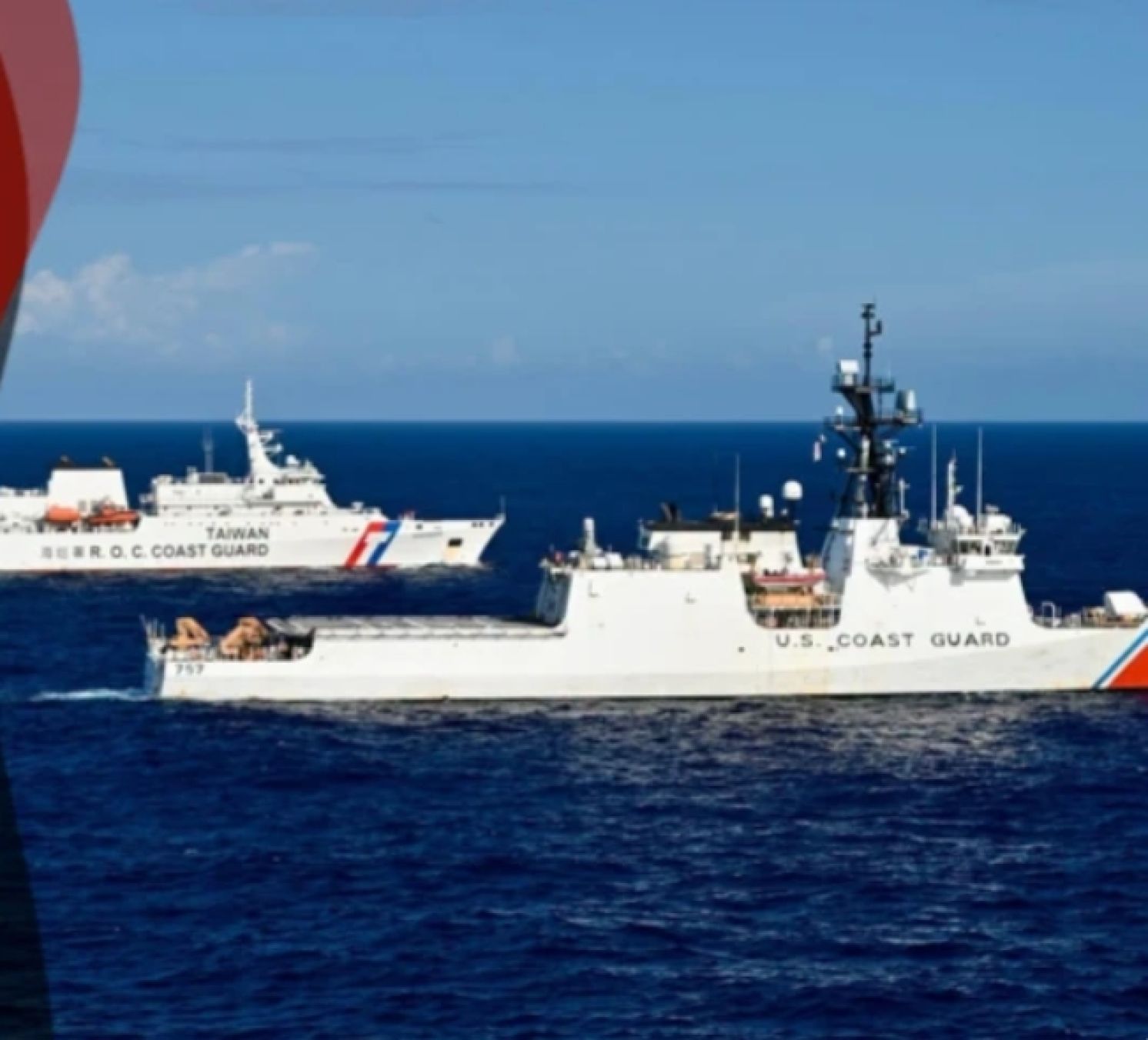
Changing Coast Guard Standoff in Taiwan Strait
United Daily News Commentary, July 29, 2026
In the past, military cooperation between the United States and Taiwan was generally conducted discreetly because of the unofficial nature of U.S.-Taiwan relations and the complexities of U.S.-China relations. This time, however, the American Institute in Taiwan (AIT) deliberately posted a photograph on its official Facebook page showing U.S. and Taiwan coast guard vessels sailing together. The accompanying message stated: “We appreciate Taiwan’s partnership on maritime security and its continued meaningful contributions to global issues.” By using the deliberately ambiguous term “partnership,” Washington was conveying substantive support for Taiwan and signaling a form of coordinated defense cooperation.
This move by the AIT was clearly intended to express disapproval of recent actions by mainland China’s Coast Guard. Under the pretext of protesting the launch of maritime boundary negotiations between Japan and the Philippines, the mainland dispatched a formation including the Daishan into waters east of Taiwan to conduct what it described as a “law-enforcement patrol.” Mainland China’s Coast Guard has announced that it will carry out “regularized” patrols in the waters east of Taiwan. International media have interpreted this as an attempt to use legal warfare to portray Taiwan’s eastern waters as being under the mainland’s effective jurisdiction.
Taiwan’s Coast Guard has repeatedly shadowed mainland vessels and issued radio warnings, protesting that the China Coast Guard’s actions violate international law. Taiwan has also clearly stated that it will avoid escalating tensions beyond 24 nautical miles from Taiwan’s shores but will never back down within that limit. Taiwan is also seeking to thwart Beijing’s attempt to normalize China Coast Guard patrols and test its ability to isolate or blockade Taiwan’s surrounding waters.
Since mainland China began regularizing its coast guard patrols around Taiwan, the United States, the United Kingdom, Germany, France, and other countries have issued public statements questioning the legitimacy of Beijing’s actions. They have also rejected the mainland’s claim that the Taiwan Strait should be treated as its internal waters. Beyond political statements, however, the actual measures taken by countries in response to the geopolitical situation in the Taiwan Strait are even more important. Recent examples include closer cooperation between Japan and the Philippines, as well as naval transits through the Taiwan Strait by various countries. These concrete actions demonstrate their opposition to Beijing’s possible expansion of its authority.
Five years ago, Taiwan and the United States signed a memorandum of understanding (MOU) establishing a Coast Guard Working Group. The nature of their cooperation has generally been treated as highly classified. Publicly known exchanges have included the United States Coast Guard assigning liaison officers to Taiwan and Taiwan sending personnel to study at the U.S. Coast Guard Academy. Although there had previously been reports that vessels from the two sides conducted exercises together in waters near a third country, these reports were never officially confirmed.
This time, the U.S. government proactively released an image showing Taiwan’s 4,000-ton patrol vessel Taipei sailing in formation with the U.S. Coast Guard Legend-class cutter Midgett. The image confirms that their joint exercises have reached a mature stage. American cooperation with Taiwan’s Coast Guard is therefore no longer limited to training and education. It has developed into a substantive “strategic alliance.” Joint U.S.–Taiwan law-enforcement operations also undermine Beijing’s justification for its own so-called “law-enforcement patrols.” More importantly, they signal to China that the American and Taiwanese “second navies” in the western Pacific have developed the ability to conduct regular coordinated operations.
The purpose of using these “second navies” is to avoid deploying conventional naval forces in a way that could cross Beijing’s red lines and trigger a full-scale military confrontation. At the same time, Washington and Taipei must clearly demonstrate their ability to counter China’s gray-zone threats and strengthen their security cooperation and mutual understanding in the waters surrounding Taiwan. This visible demonstration of American support could reassure neighboring countries as they respond to China’s expanding power and could contribute to regional stability.
The AIT’s decision to “break a taboo” may also be understood as a response to Beijing’s recent harsh criticism of AIT Director Raymond Greene, whom Beijing described as behaving like an “overlord.” The image of U.S. and Taiwan coast guard vessels sailing together also conveys Washington’s official commitment to “deterring conflict.” Beijing will certainly not welcome this development, but it illustrates the complexity and sensitivity of interactions among the United States, China, and Taiwan. All sides appear to share an understanding that they must carefully avoid an armed confrontation. Nevertheless, the war of words among Washington, Beijing, and Taipei has never truly stopped.